

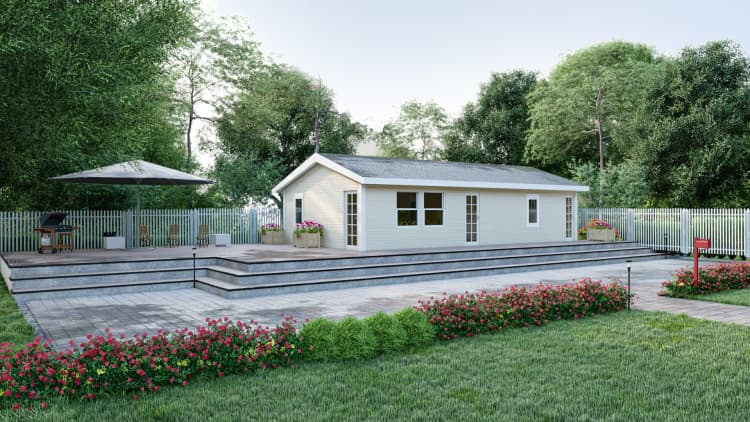
$100,000 gets you a garage conversion. $550,000 or more gets you a large, detached, site-built unit. That’s the honest spread on ADU costs in the Bay Area, and where your project lands inside it comes down to what you build and what your lot throws at you. A new detached ADU of 600 to 800 square feet, the most popular scope, usually runs $300,000 to $450,000 all-in. On a per-square-foot basis, most Bay Area accessory dwelling units land between $400 and $600 per square foot once you include design, permits, site work, and utility connections.
Here’s the trap. The price advertised for a unit, especially a prefab base price, almost never includes the site work, foundation, and utility connections that make an ADU habitable. This guide breaks ADU cost down by build type, by size, and by the specific factors that push the number up or down, plus how Bay Area homeowners actually pay for it.
ADU Cost by Type in the Bay Area
The single biggest cost decision is which kind of ADU you build. Here is how the four common paths compare in 2026. Treat these as planning ranges. Your site conditions will move the final number.
Garage Conversion or JADU: $100,000 to $180,000
Converting an existing garage, or carving a junior ADU (JADU, up to 500 square feet) out of your existing home, is the least expensive path because you already have a foundation, walls, and a roof. You are adding a kitchen, a bathroom, insulation, and separate utilities rather than building from the ground up. A JADU with a shared or compact kitchen can be the lowest-cost option of all in the right house.
Prefab / Modular Detached ADU: $200,000 to $400,000
Prefab and modular units are built in a factory and set on a foundation on your lot. The factory price is often more predictable and the on-site construction window shorter. But the number you see advertised is the box only, and you still pay separately for the foundation, site prep, and utility connections. Our prefab ADU guide covers how these are built and who they suit, and you can browse layouts on our ADU floor plans page.
Attached Site-Built ADU: $250,000 to $400,000
An attached ADU shares a wall with the main house. That saves you one wall and sometimes shortens the utility runs, but you still pay for a new foundation, framing, roof, and a full kitchen and bath. Costs sit between a garage conversion and a detached build.
Detached Site-Built ADU: $300,000 to $550,000+
A ground-up detached ADU is the most expensive because you are paying for everything new: foundation, framing, roof, siding, and full utility runs to a separate structure. It’s also the most flexible, and it typically adds the most value and rental appeal. Larger units (900 to 1,200 square feet) or difficult sites push well past $550,000.
What Drives ADU Costs Up in the Bay Area?
Site Work and Utility Connections
This is the biggest wildcard and the line item that surprises homeowners most. Trenching for water, sewer, gas, and electrical; upgrading your main electrical panel to carry a second dwelling; and running those lines across the yard can add $20,000 to $60,000 on its own. If the ADU is far from existing connections, the number climbs further.
Foundation and Site Conditions
A flat, accessible lot with good soil is the cheap scenario. A sloped lot that needs grading or a stepped foundation, rocky soil, a high water table, or tight access that limits equipment can each add tens of thousands of dollars. Bay Area hillside lots in particular carry a real foundation premium.
Size and Finish Level
Because an ADU is a complete dwelling, small units carry little economy of scale. The kitchen and bath cost roughly the same whether the unit is 400 or 800 square feet. Finish level then layers on top: builder-grade versus designer cabinetry, flooring, and fixtures can swing the budget 20 percent or more.
Permitting and Impact Fees
California has capped or waived many ADU fees in recent years, and impact fees are waived entirely for ADUs under 750 square feet. That has lowered the entry cost meaningfully. You still pay for permits, plan check, and school fees in some cases, and cities vary. The state also requires a decision on a complete application within 60 days, which keeps timelines predictable.
ADU Cost by Size
As a rough per-square-foot planning tool for new site-built ADUs in the Bay Area, most projects land in the $400 to $600 per square foot range all-in. That translates to:
- 400-500 sq ft studio/1-bed: roughly $220,000 to $320,000
- 600-800 sq ft 1-2 bed: roughly $300,000 to $450,000
- 900-1,200 sq ft 2-3 bed: roughly $420,000 to $650,000+
Garage conversions run well below this per-square-foot band because the shell already exists. You can see real Bay Area layouts and sizes on our ADU floor plans page.
How Bay Area Homeowners Pay for an ADU
Most Bay Area ADUs are financed one of four ways, and the right choice depends on how much equity you have and whether the rental income is part of your plan.
- HELOC (home equity line of credit): popular for homeowners with substantial equity; flexible and familiar, though rates are variable.
- Cash-out refinance: pulls equity out at a fixed rate; makes sense when you can refinance the whole mortgage on favorable terms.
- Renovation or construction loan: can underwrite based on the home’s value after the ADU is built, which helps when current equity is tight.
- Cash or rental-income offset: some homeowners pay outright or lean on the rental income the unit will generate to cover the financing payment.
For a deeper look at loan types and lenders, see our financing options resource.
Rental Income and ROI
The reason ADUs pencil out for so many Bay Area homeowners is that the unit produces income against a fixed financing payment. Whether it actually pencils depends on where your neighborhood’s rental comps land, so pull those before you build the income into a budget. Once the rent covers a meaningful share of the payment, the unit pays itself off over time. A permitted ADU also adds rentable square footage and flexibility that Bay Area buyers pay a premium for, given the region’s chronic housing scarcity. The key word is permitted. An unpermitted unit can complicate a future sale rather than add value.
Red Flags on ADU Bids
After speaking with more than 350 Bay Area contractors and vetting fewer than 10 percent of them into our network, we have learned to spot the warning signs in an ADU bid before a shovel hits the ground.
- The price excludes site work and utilities. This is the most common way an ADU bid looks cheap. If the quote does not spell out foundation, trenching, panel upgrade, and utility connections, that money is coming later.
- No license number on the bid. Every licensed contractor in California has a CSLB license number. Verify any license at cslb.ca.gov in about 30 seconds.
- The bid is 30 percent or more below the others. Labor and material costs are roughly the same for every contractor in this market. A bid far under everyone else usually means an excluded scope or lower-grade construction.
- Large upfront deposit. California law limits contractors from requesting more than 10 percent of the total project cost or $1,000, whichever is less, as an initial deposit.
- No ADU track record. ADUs have their own permitting quirks and utility rules. Ask to see completed, permitted ADU projects rather than a portfolio of kitchen and bath remodels.
How Renovation Bridge Fits In
ADUs are unforgiving of inexperience. The permitting, the utility connections, and the site work all reward a builder who does this every week. At Renovation Bridge, every contractor in our network is license-verified, insured, and bonded, and we match you specifically with builders who have completed permitted ADUs in your area. Part of that vetting happens on their active job sites, where we ask the subcontractors whether they get paid on time. A general contractor who can’t pay subs will watch those subs stop showing up, and your timeline collapses with them. NBC Bay Area covered our vetting process because it’s genuinely different from what aggregator platforms do.
Most homeowners receive at least three bids, so you can compare full, itemized scopes instead of a base price that quietly leaves out the expensive parts. The service is completely free to homeowners. Browse layouts on our ADU floor plans page, explore the cities we serve, or visit our FAQ page to see how the process works.
Frequently Asked Questions
How much does an ADU cost in the Bay Area in 2026?
ADU costs in the Bay Area range from about $100,000 for a garage conversion to $550,000 or more for a large detached, site-built unit. A typical new detached ADU of 600 to 800 square feet runs roughly $300,000 to $450,000 all-in. On a per-square-foot basis, most Bay Area ADUs land between $400 and $600 per square foot once design, permits, site work, and utility connections are included. Your specific cost depends on the build type (garage conversion, attached, detached, or prefab), the size, your site conditions, and the finish level. Getting itemized bids from ADU-experienced contractors is the only reliable way to set a real budget.
What is the cheapest type of ADU to build?
A garage conversion or a JADU (junior ADU) is almost always the least expensive path, typically $100,000 to $180,000, because you are working within an existing structure and foundation rather than building new. A JADU is up to 500 square feet carved out of the existing home, often with a compact kitchen and sometimes a shared bath, and in the right house it can be the lowest-cost option of all. Detached, ground-up ADUs cost the most because you are paying for a new foundation, full framing, a new roof, and fresh utility runs. Prefab and modular units sit in the middle. They are often faster and more cost-predictable than stick-built, but they still require a foundation, site prep, and utility connections that the factory price does not include.
Why are Bay Area ADUs so expensive?
An ADU is a complete, permitted dwelling with its own kitchen, bathroom, HVAC, and electrical, so it carries nearly all the systems of a full house at a smaller scale. Small square footage means little economy of scale. Bay Area labor runs 30 to 50 percent above national averages, and site work is the wild card: trenching for water, sewer, gas, and electrical; upgrading the main panel; grading a sloped lot; or hitting rock or a high water table can each add tens of thousands of dollars. Permitting and city impact fees add more, though California has capped or waived many ADU fees in recent years. The factory or base price you see advertised rarely includes these site and connection costs, which is why real all-in numbers surprise many homeowners.
How long does it take to build an ADU in the Bay Area?
A garage conversion typically takes 3 to 5 months from permit to completion. A detached, site-built ADU usually runs 8 to 14 months including design and permitting. Prefab and modular units can shorten the on-site construction window because the box is built in a factory while site work happens in parallel, but you still need design, permits, a foundation, and utility connections, so the total timeline is often 6 to 10 months. California’s ADU law requires cities to approve or deny a complete application within 60 days, which has made permitting faster and more predictable than it was a few years ago.
How do people pay for an ADU in the Bay Area?
The most common ways to finance a Bay Area ADU are a home equity line of credit (HELOC), a cash-out refinance, a renovation or construction loan, or cash. Homeowners with substantial equity often use a HELOC or cash-out refi because rates are lower and the process is familiar. Renovation and construction loans can underwrite based on the home’s value after the ADU is built, which helps if current equity is tight. Some homeowners offset the cost with the rental income the ADU will generate, which can cover a meaningful share of the financing payment. Check comparable rental listings in your own neighborhood to estimate that figure, since it varies widely by city and unit size.
Does an ADU add value to my Bay Area home?
In most cases, yes. A permitted ADU adds rentable square footage and options: space for family, a home office, or rental income. Bay Area buyers pay a premium for all of it given the region’s housing scarcity. The value added depends on location, build quality, and whether the unit is legally permitted; unpermitted units can actually complicate a sale. Beyond resale, many homeowners build an ADU for the ongoing rental income or to house family, and value it for that cash flow and flexibility rather than the resale bump alone.